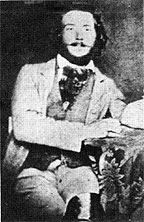
Frank Gardiner Jack Bradshaw, who called himself "The Last of the Bushrangers", and wrote The True History of the Australian Bushrangers
(which is quite untrue in many places), had a good word to say for
almost all the bushrangers. But he admitted that he could not have much
to say in favour of Gardiner: "he was a dirty terror to poor
travellers." But singers in Gardiner's country found a lot to say in
favour of the bushranger, and Bradshaw printed a version of this song,
which flatly contradicts his own comment by calling Gardiner "the poor
man's friend."
The folk song
collector, John Meredith, recorded another set of the words and a tune
from an old singer, Mrs. Popplewell, some years ago. It is Mrs.
Popplewell's version that Gary Shearston sings here.
Sgt. Middleton
- a police sergeant whom Gardiner wounded in an encounter in 1862 when
Middleton and a trooper tried to arrest Gardiner on suspicion of
cattle-duffing.
troopers - mounted police.
Queen's evidence - turned informer for reward.
THE WILD COLONIAL BOY
The Wild Colonial Boy
is a very mysterious personage. There are many versions of his ballad
and they do not all tell the same story. But most tell the story as in
the version used here, though with the small disagreements which almost
invariably creep into any ballad which is passed on by word of mouth.
It matters little that some versions of the ballad say the Wild
Colonial Boy "left his father's home" when he was fifteen, others when
he was sixteen; or that some say he "commenced his wild career" in
1861, others in 1863, or -as in this version -1864. It is odd, however,
that the singers cannot agree whether his name was Dowling, Doolan or
Duggan . . .
The ballad has
been the cause of much research and much ingenious speculation. The
story usually told by the ballad is not that of any bushranger known to
the chroniclers of bushranging in the state of Victoria. So some think
that the Wild Colonial Boy is a bushranger of fiction only. Others,
impressed no doubt by circumstantial detail offered by the ballad and
its air of historical authenticity, believe that he will be shown to be
a bushranger of fact - if only the historical records are searched
carefully enough. (And there has been much searching of the records, in
Ireland as well as in Australia.) The ballad has long been known in
Ireland, and today is perhaps sung more often there than in Australia.
But it does not state whether the Wild Colonial Boy was born in
Castlemaine in the state of Victoria, or Castlemaine in the County
Kerry; and there is still no proof that the Wild Colonial Boy was an
historical person.
There are
some ballads which tell the story of Bold Jack Donahue, but call him
the Wild Colonial Boy; and there are some which contain elements from
the story of Jack Donahue and the usual Wild Colonial Boy story of the
present version. Some researchers think that The Wild Colonial Boy is a fictional ballad which developed slowly out of the historical ballad of Bold Jack Donahue. Still others believe that Bold Jack Donahue and The Wild Colonial Boy
began as independent ballads, but were confused by some bush singers
producing crosses of a kind well-known in the balladry of other lands.
It has been said that a small boy sang The Wild Colonial Boy
for the Kelly Gang in Glenrowan on the night before their last battle
with the police. Maybe by then the song had become - as it certainly
did later, along with Bold Jack Donahue - one of the most widely sung
of all bushranger ballads.
Folk
song collectors in Queensland recently collected a version of the song
which is much like the one used here, but ends with the Wild Colonial
Boy killing or wounding the police troopers and escaping. The old
bushman who sang it claimed it was the authentic and proper way of
telling the story and that the usual ending was meant only for singing
in the presence of policemen or other champions of government authority.
The
ballad was, and is still, known to folk singers in parts of Canada and
the United States of America, as well as Ireland. The North American
versions seem to have reached there by way of Ireland; for that matter,
it is possible that the song is Irish by birth and not Australian
anyway.
Gary Shearston
learnt the present version of the song from the singing of Sally Sloane
(from a tape recording made by Edgar Waters). He has slightly
re-arranged the order of one or two words and lines and added the
fourth verse to the song from a version sung by A.L. Lloyd. The fifth
verse of the present version is used as a chorus for many versions of
both The Wild Colonial Boy and Bold Jack Donahue.
Judge McEvoy - there was a Judge Macoboy who, according to family tradition, was bailed up by an unknown bushranger near Beechworth in 1861.
acted square - honourably the opposite of "on the cross" (see The Maryborough Miner).

 Site Index