NOTES 5:
Ben Hall - biographical notes
Ben Hall
The Death of Ben Hall
The Streets of Forbes Ben
Hall was born at Wallis Plains, Maitland, New South Wales, in 1837*.
Both his parents had been transported to Australia as convicts. He grew
up in the bush on the Hunter River, but in the 1840s the family moved
west, to the Lachlan. Hall worked as a stockman for John Walsh of
Wheogo Station in the Weddin Mountains. Walsh had been transported to
Australia for life in 1823. In 1856, Ben Hall married one of Walsh's
daughters and settle down on a small run at Sandy Creek, near Wheogo.
He was in partnership with another son-in-law of Walsh, John McGuire.
When Walsh died in 1858, the two of them helped his widow, her daughter
Kitty, and Kitty's husband, John Brown, to run Wheogo as well. Kitty
was later to run off to Queensland with Frank Gardiner.
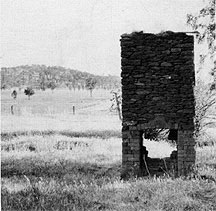
The
chimney is all that remains of John Walsh's "Wheogo" homestead in the
Weddin Mountains, N.S.W., where Ben Hall worked and met Walsh's
daughter, Bridget, whom he later married. In the distance is Wheogo
Mountain on top of which Frank Gardiner and his gang buried the
proceeds of their Forbes gold coach robbery at Eugowra.
Hall
and McGuire had friendly contacts with Gardiner and others of his gang,
but they seem to have both been honest men - which is not to say that
they would have denied Gardiner a meal at their table or a roof over
his head for the night. Ben Hall was arrested early in 1862 and charged
with highway robbery-under-arms, seemingly without good reason. He was
acquitted. Hall and McGuire were both arrested after Gardiner's gang
robbed the Forbes gold coach at Eugowra - again, seemingly, without
good reason - and both were acquitted. McGuire, however, spent six
months in gaol before his acquittal on this charge, and while Hall was
in gaol, the police burned down his homestead and mustered his cattle
into a paddock, leaving them there to starve to death. Hall, in fact,
seems to have been one bushranger who really was driven into
bushranging by police persecution.
Hall
became leader of a gang which included men who had formerly been led by
Gardiner. The gang carried out some daring robberies, but Hall seems to
have been even more interested in pulling the nose of authority and
making fools of the police, than in gathering up loot. The gang raided
Bathurst and some other fairly large towns for amusement. They took
over the entire town of Canowindra and held a carnival for three days,
and one of the ballads about the gang says:
Some day to Sydney city
We mean to pay a call,
And we'll take the whole damn country,
Says Dunn, Gilbert and Ben Hall.
Hall's
reign as "the most notorious bushranger ever spawned in New South
Wales" came to an end when a party of police caught up with him alone
one day in 1865. Hall tried to escape and did not return their fire.
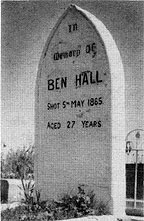
The police pumped some thirty bullets into his body.
Ben
Hall was the ideal type of bushranger -modest, game, a most skillful
bushman, chivalrous to women, no robber of the poor, averse to killing
(though some of his gang were readier to shoot), gaily defiant of the
police, the wealthy, and all colonial authority. Popular admiration
shows clearly in all the many ballads about him.
*Editor's
Note - Ben Halls' birthplace as Wallis Plains comes via Barbara Dunn, a
descendant of Ben Hall, from information based on family research.
Earlier research had suggested that Ben Hall's birthplace was Breeza.

 Site Index